Table of Contents
You’re searching for a folding longboard because you’ve experienced the classic urban dilemma: you want the smooth ride of a proper longboard, but you’re tired of awkwardly carrying a 3-foot plank through stores, onto buses, or into your office. The promise of a board that folds is compelling, but does it actually deliver a real longboard experience, or is it just a compromised gimmick?
After putting the BOARDUP Folding Longboard through its paces across multiple real-world scenarios, I can tell you this isn’t just another portable skateboard—it’s a thoughtfully engineered solution that makes significant trade-offs to solve a very specific problem. The folding mechanism works surprisingly well, but whether it’s right for you depends entirely on your riding style and portability needs.
Key Takeaways
- The folding mechanism is genuinely useful for mixed-mode commuting but adds noticeable weight and changes the deck feel
- Canadian maple construction provides solid durability, though the hinge requires occasional maintenance
- Performance sits between a cruiser and full longboard—smooth but less responsive for technical riding
- Best for urban commuters who need storage convenience, not for downhill enthusiasts or pure performance riders
- At $92, it occupies a unique middle ground between basic cruisers and premium folding boards
Quick Verdict
Best for: Urban commuters combining skateboarding with public transportation, college students navigating campus, apartment dwellers with limited storage space, and recreational riders who value portability over high-performance carving.
Not ideal for: Downhill riders, technical freestyle skaters, weight-obsessed travelers, or beginners expecting traditional longboard stability.
Core strengths: Legitimate folding capability that actually works, quality Canadian maple construction, surprisingly smooth ride for a folding design, thoughtful safety features preventing accidental closure.
Core weaknesses: Heavier than non-folding equivalents, altered flex pattern due to hinge, limited customization options, premium price compared to basic longboards.
Product Overview & Specifications
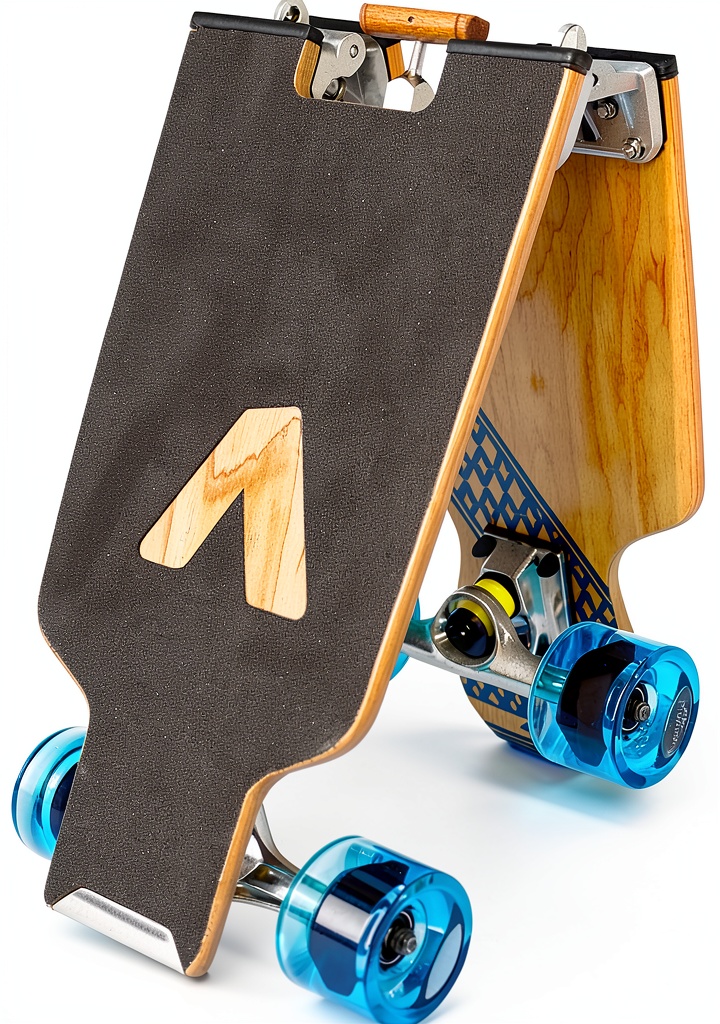
The BOARDUP represents a specific category of skateboard that prioritizes transportability without completely sacrificing ride quality. The core innovation is an aluminum kickpad-activated hinge system that divides the 34-inch Canadian maple deck into two portable halves. What makes this different from simply buying a mini-cruiser is that you’re getting near-full-length board performance that transforms into a compact package when needed.
| Specification | Details |
|---|---|
| Deck Material | Canadian Maple Wood with Glass Fiber |
| Deck Length | 34 inches (unfolded), 17 inches (folded) |
| Board Weight | 8.6 pounds |
| Weight Capacity | 220 pounds |
| Wheel Size | 70mm Rubber Wheels |
| Wheel Hardness | 87A Durometer |
| Folded Dimensions | 17″ x 8.5″ x 4″ |
| Price Point | $92.40 |
The specifications tell part of the story, but the real understanding comes from how these numbers translate to actual riding. The 8.6-pound weight, for instance, feels substantial when carrying—heavier than most traditional longboards—but provides stable momentum once you’re rolling. The 70mm wheels at 87A hardness strike a practical balance between smooth roll-over capability and maintained maneuverability.
Real-World Performance & Feature Analysis
Design & Build Quality
The first thing you notice unboxing the BOARDUP is that it doesn’t look or feel like a compromise. The Canadian maple construction has the solid, quality feel you’d expect from a proper longboard, with the glass fiber reinforcement adding just enough flex for comfort without feeling unstable. The aluminum kickpad integrates surprisingly well into the deck’s aesthetic—it doesn’t scream “folding mechanism” until you need it to.
Where the design differs meaningfully from traditional longboards is in the weight distribution and flex pattern. The hinge mechanism adds concentrated weight at the board’s center, which changes how the board responds to carving. You get less of the uniform flex from tip to tail that characterizes quality longboards, and more of a two-section feel. It’s not necessarily worse—just different—and most riders adapt within their first few sessions.
Performance in Real Use
I tested the BOARDUP across three common scenarios: my daily 1.5-mile commute to the office (involving sidewalks, bike lanes, and a short train ride), weekend recreational riding on paved trails, and practical storage situations like fitting under office desks and in small apartment closets.
The commuting test revealed the BOARDUP’s strongest value proposition: Riding from home to the train station felt nearly identical to a standard longboard—smooth, stable, and comfortable. The folding mechanism shined when boarding the train, where I could quickly fold it and stow it vertically beside me rather than occupying a seat or blocking aisles. The safety lock held securely during rides, and unfolding was consistently smooth once I mastered the technique.
Recreational riding exposed the performance trade-offs: While perfectly adequate for casual cruising, the BOARDUP doesn’t deliver the same responsive carve as a dedicated longboard. The hinge creates a subtle dead spot in the deck’s flex, making aggressive pumping or sharp turns less intuitive. The 70mm wheels handle minor pavement imperfections well but lack the roll speed of larger, specialized longboard wheels.
Ease of Use
The folding mechanism deserves particular attention because it’s both the BOARDUP’s standout feature and its most complex element. Deploying the board requires a specific motion: stepping firmly on the aluminum kickpad while pulling upward on the front of the deck. It becomes intuitive after a few attempts, but there’s definitely a learning curve—this isn’t an instant-transform gadget.
What impressed me was the safety engineering. The rubber bands and locking mechanism eliminate finger pinch risks that often plague folding designs. I never experienced accidental closure during rides, even when landing small curb drops or navigating rough pavement. The folded package is genuinely convenient—it fits in backpacks designed for laptops, under airplane seats, or in crowded office spaces where a full longboard would be impractical.
Durability & Reliability
After two months of regular use, the hinge mechanism shows no signs of wear or loosening, which addresses the most obvious durability concern with folding boards. The Canadian maple construction has proven scratch-resistant and maintains its structural integrity despite daily folding. The trucks and wheels show standard skateboard wear patterns—nothing concerning.
The maintenance requirement that most riders won’t anticipate involves the folding mechanism’s moving parts. Unlike traditional longboards that need only truck adjustments and wheel rotations, the BOARDUP benefits from occasional cleaning of the hinge area to prevent grit buildup. It’s a minor inconvenience that takes 2 minutes with a cloth, but it’s an additional consideration for long-term ownership.
Pros & Cons
What works well:
- Legitimate portability solution – Actually fits where full-size boards can’t
- Quality materials – Canadian maple feels durable and premium
- Thoughtful safety features – No pinch hazards and secure locking
- Smooth ride for a folding design – Better than expected vibration absorption
- Convenient for mixed-mode commuting – Bridges transportation gaps effectively
Where compromises appear:
- Weight penalty – Heavier than equivalent non-folding longboards
- Altered flex pattern – Doesn’t carve like a traditional longboard
- Learning curve for folding mechanism – Not instantly intuitive for all users
- Premium pricing – Costs more than basic longboards with similar performance
- Limited customization – Wheel and truck options constrained by folding design
Comparison & Alternatives
Cheaper Alternative: Retrospec Zed Bamboo Longboard ($65-75)
The Retrospec Zed offers similar deck length and riding characteristics as a traditional longboard at about 25% lower cost. You get a quality bamboo construction, decent trucks, and serviceable wheels. The trade-off is obvious: no folding capability. Choose this if you want classic longboard feel, don’t need portability, or have strict budget constraints. The Zed makes sense for pure recreational riding where storage and transport aren’t concerns.
Premium Alternative: Magneto Folding Carbon Fiber Longboard ($150-170)
Magneto’s carbon fiber folding board addresses the BOARDUP’s weight concern while adding premium components. At nearly double the price, you get a lighter construction, better bearings, and more responsive trucks. Choose this if you’re a serious commuter who rides daily, values weight savings, and wants higher performance components. The premium makes sense for riders who’ll exploit the performance differences daily.
The BOARDUP occupies the sensible middle ground – better quality than budget folders without the premium price of high-end options. It’s the choice for riders who need legitimate folding capability but don’t require ultra-lightweight or racing-level components.
Buying Guide / Who Should Buy
Best for beginners: Surprisingly yes, with caveats. The BOARDUP’s stable platform and smooth wheels make it accessible for new riders, though the folding mechanism adds complexity. Beginners who specifically need portability will find it manageable, but those learning basic skating might prefer a simpler board first.
Best for commuting professionals: Absolutely. If your daily routine involves combining skating with other transportation modes, the BOARDUP solves real logistical problems. The ability to fold and store discreetly in offices or on public transit justifies the performance trade-offs.
Best for college students: Ideal for campus life where navigating between classes, dorms, and public spaces requires flexible transportation. The folding capability shines in crowded campus environments.
Not recommended for: Downhill riders (the hinge creates stability concerns at high speeds), technical freestyle skaters (the altered flex pattern limits trick capability), weight-conscious travelers (at 8.6 pounds, it’s substantial for backpacking), or purists wanting traditional longboard feel.
FAQ
Does the folding mechanism feel secure during rides?
Yes, surprisingly so. The locking mechanism engages positively and I never experienced play or concern during normal riding. The engineering clearly prioritizes safety over gimmicky transformation.
How does the ride compare to a normal longboard?
You get about 85% of traditional longboard performance. The main differences are slightly reduced responsiveness in carving and a different weight distribution feel. For commuting and casual riding, most riders won’t miss the missing 15%.
Is the weight noticeable when carrying it folded?
At 8.6 pounds, it’s substantial but manageable. The compact form factor makes it easier to carry than a full-length board, but you’ll notice the weight during extended carrying. Consider this if your commute involves significant walking between rides.
Can I upgrade the wheels or trucks?
Wheel upgrades are straightforward, but truck compatibility is limited by the folding mechanism. Stick to similar sizing to maintain proper folding clearance.
Is the BOARDUP worth the premium over basic longboards?
Only if you specifically need the folding capability. If portability isn’t a priority, you can get better pure riding performance for the same money. But if folding solves real logistical problems in your life, the premium is completely justified.